
Discover the Enchantment of Castles
Explore our collection of majestic castles, where history meets luxury, and every stone tells a story of romance, power, and timeless elegance.
Explore the enchanting beauty and history of majestic castles, palaces, and chateaux of Europe. Castles originated in the 9th & 10th centuries and were used for defense, residences, & administration. They were also used as offensive structures.
Castles were symbols of status & authority.
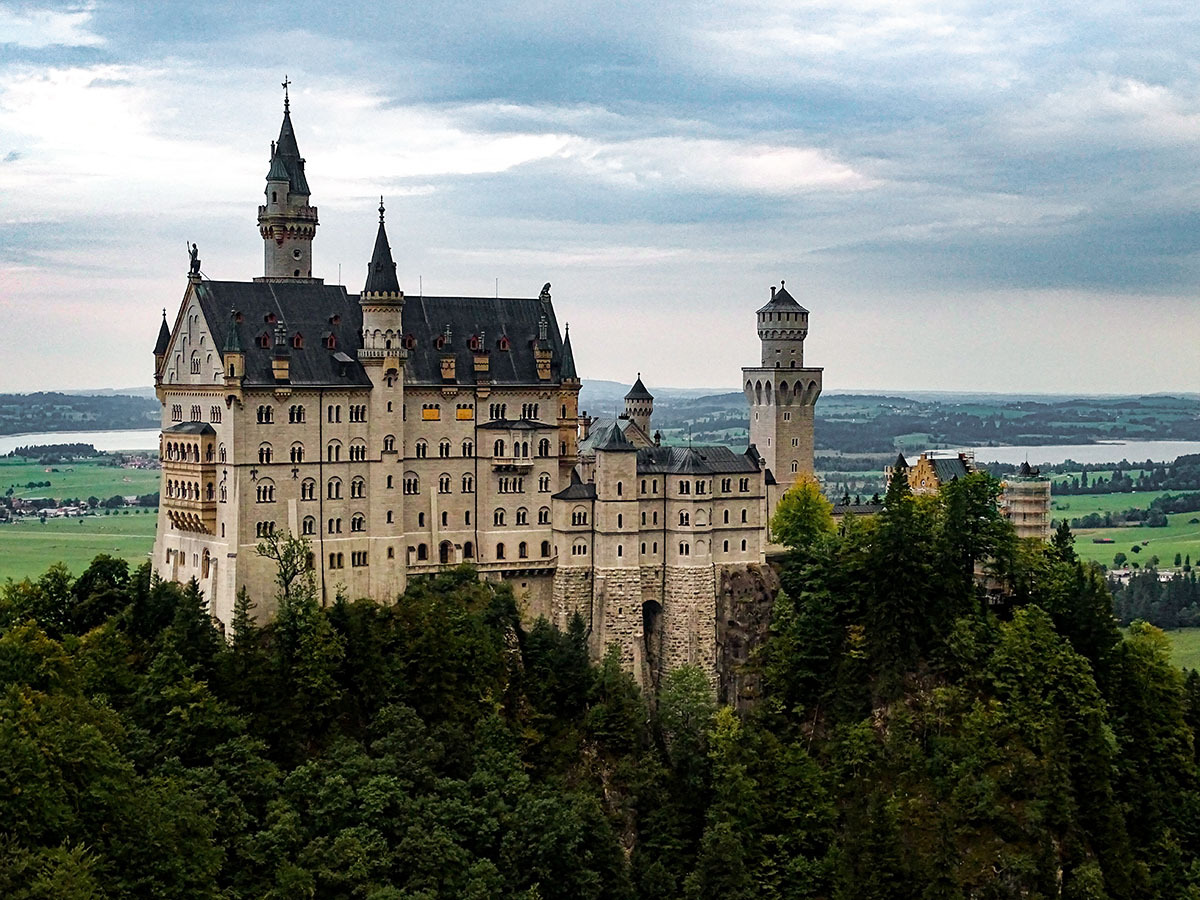
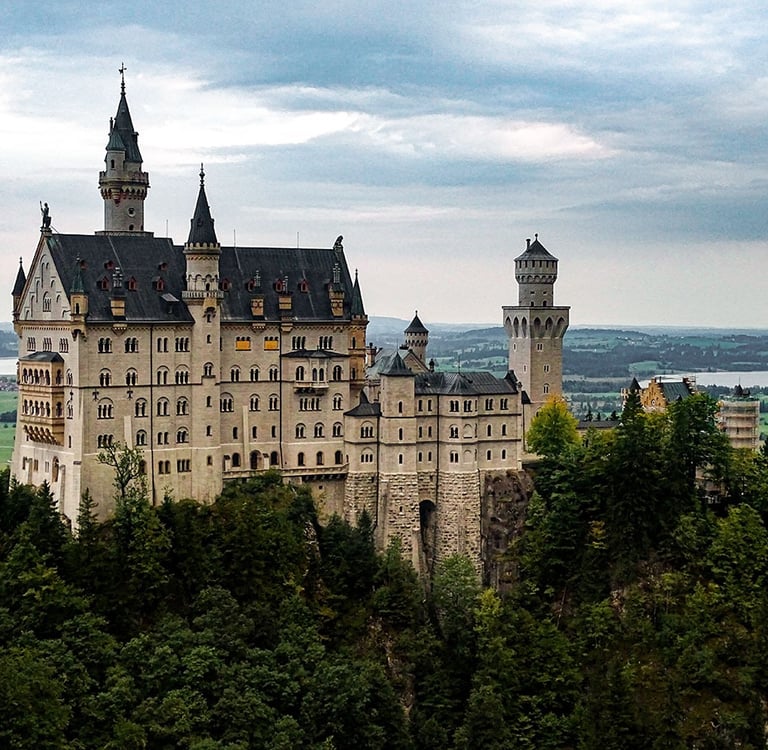
Neuschwanstein Castle, Bavaria, Germany
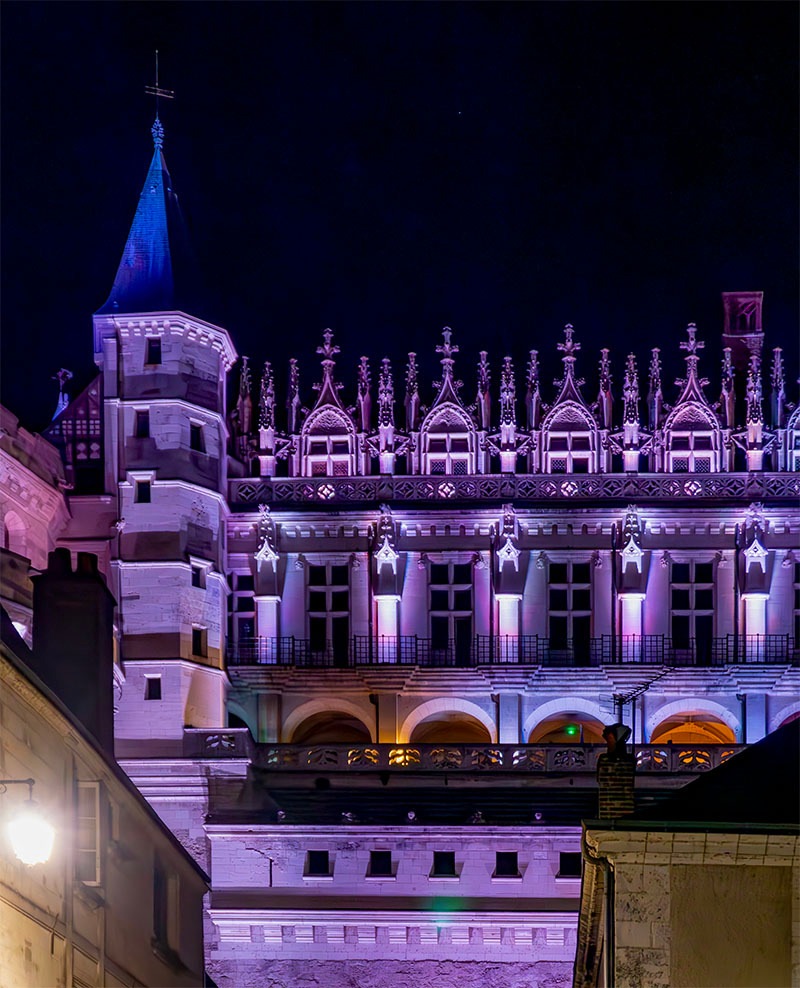
Amboise Castle, France
Origins Of Castles
The origins of castles goes back to ancient civilizations around 4,000 BC, where communities in Asia, the Middle East, and North Africa began fortifying their settlements using natural features like rocks and cliffs, as well as constructed walls of stone and wood.
In Europe, similar defensive ideas appeared by 2nd century BC by building oppidas (hill forts), to protect themselves from the advancing Roman armies that were conquering regions such as France & Germany. However, the Romans' had more advanced military engineering in constructing durable stone forts and their sophisticated siege technology made their military defenses significantly more effective than the basic hill forts used by the locals. After the fall of the Roman Empire, the tradition of building castles evolved, marking a significant shift in fortification techniques and architectural styles across Europe.
Tradition of building castles declined in Europe during and after the fall of the Roman Empire (around 5th century AD). Their first mass appearance happened in 9th and 10th century AD after the fall of Carolingian Empire, which left large amount of military nobility responsible for the lands of France and Germany. Wanting to secure their rule, every of those lords started building their own wooden defensive structures, which were used not only for military purposes, but also as the centers of their local government, economy and justice. They were usually created from wood, placed on top of a manually created motts, sometimes with a circular ditches, rampants, banks, and stone walls. Central structure (personal residence of the lord, sometimes with public rooms for government work) was often made from stone, but was usually not secured against fire because of wooden doors, roof and windows. During 9th and 10th centuries, creation of forts and castles was usually not controlled by any government (anyone could make one and claim their land, or use it to protect their land against invaders), which led to the creation of tens of thousands castles in the central Europe.
Mott-&-Bailey
Romanesque Architecture
Gothic
Renaissance
Baroque
Architectural Styles Features
Crusades & Templar Castles
The Crusades (11th - 14th centuries) significantly transformed European perceptions of castles and fortifications. They were a series of religious wars in which European Christian forces traveled to the Holy Land to capture and defend sacred territories.
Once they arrived, Crusaders faced constant military threats. To maintain control, they needed:
Strong defensive bases
Supply and communication hubs
Safe refuges for troops and pilgrims
This led to a massive wave of castle-building across the region.
Castles constructed in the Crusader states became blueprints for many European strongholds, particularly in the 13th century. Prominent military orders such as the Knights Hospitaller, Knights Templar, and Teutonic Knights were instrumental in this architectural evolution, creating fortifications characterized by multiple rings of fortified walls, strategic towers for defense, and bridges—either wooden or rope—that could be demolished to hinder advancing enemies. This ingenuity not only enhanced the military capabilities of the castles but also established a new standard for defensive architecture across Europe, reflecting the lessons learned during the Crusades.
Late Medieval Period
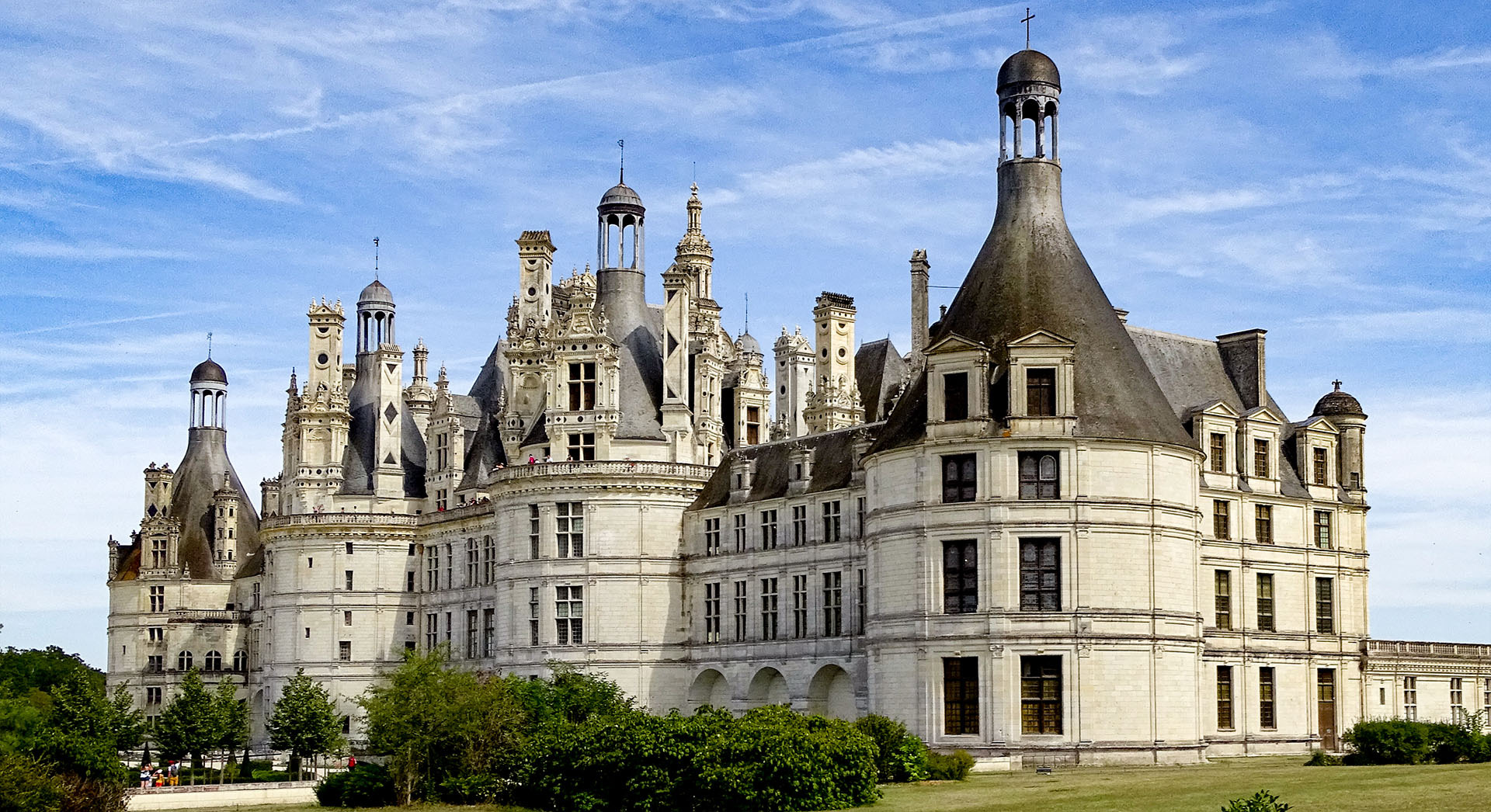
During the late medieval period, the introduction of gunpowder and cannons forced further changes in castle design. Walls became lower but much thicker to withstand artillery fire, and gunports were added to accommodate firearms. At the same time, castles gradually became more comfortable as residences, with larger windows, improved living quarters, and more attention to interior spaces. By the Renaissance period, the defensive role of castles had significantly diminished, and many were transformed into grand residences that emphasized aesthetics, symmetry, and luxury over military strength. Structures like Château de Chambord illustrate this shift, blending elements of traditional fortifications with ornate architectural design.
The introduction of gunpowder artillery in the 14th century marked a revolutionary change in military architecture across Europe. This advancement led to the construction of fortified defenses designed to accommodate cannons, enabling defenders to fire from behind walls through vertical slits. As defensive artillery castles emerged throughout Europe and later in the New World. By the mid-15th century, heavy artillery had become the preferred method for besieging these strongholds. In response, castle builders attempted to reinforce their structures with thicker walls and curved sides to deflect cannon fire.
By the end of the 16th century, Europe was a landscape dotted with an estimated 75,000 to 100,000 castles, varying from intact marvels to ruins of a bygone era. As European powers sought to expand their influence across the Atlantic, they constructed numerous defensive structures, including castles, forts, citadels, and fortified manor houses, primarily by the Spanish and French. These colonial edifices effectively mirrored the architectural styles and construction techniques found in their European counterparts. The blend of functionality and artistry in these fortifications highlighted the era's military needs while also reflecting the cultural heritage that settlers brought with them, forging a connection between the Old World and the New.
Castles, Palaces & Forts by Country
Germany
Schloss Neuschwanstein
Hohenzollern Castle
Schloss Nymphenburg
Burg Eltz
Austria
Hohensalzburg Fortress
Hellbrunn Palace & Trick Fountains
France
Mont St. Michel
Chateau de Chambord
Chateau de Amboise
Chateau de Cheverny
Chateau de Plessis
Chateau de Versailles
Chateau de Vincennes
Chateau de Chillon
Château de Fontaine-Henry
Italy
Sforza Castle (Castello Sforzesco)

The castles are breathtaking; their history and grandeur truly make you feel like royalty.
Emily Stone


Visiting these magnificent forts was a dream come true; their beauty is simply unparalleled.
James Clark


★★★★★
★★★★★
5 Cs Of Europe
Explore Europe's Castles, Cathedrals, Chocolates, Cheese, & Champagne.
Join to get the latest updates and travel tips from 5CsofEurope
© 2026. All rights reserved.
Site built by DevangOnline